When people think about losing weight, they think about walking and food. Strength training is the part most people skip, and it matters more every year.
Why it matters more with age
From around 30, muscle mass slowly declines, by about 3 to 8% per decade, and faster after 60.1 Less muscle makes stairs, shopping bags and getting up from the floor harder. Strength training is the most reliable way to slow that.
How often
The WHO recommends muscle-strengthening activities that work all major muscle groups on two or more days a week.2 Even people who can only exercise on weekends seem to benefit: in a pooled analysis of more than 63,000 adults, one or two sessions a week that reached the recommended amount was linked with about a 30% lower risk of death than being inactive.3
Four moves to start
| Move | How | Reps |
|---|---|---|
| Sit-to-stand | From a sturdy chair, lean forward, press through your whole feet, stand, sit back slowly. | 8 to 12 |
| Wall push-up | Hands on the wall at shoulder height, body in one line, elbows at about 45 degrees. | 8 to 12 |
| Glute bridge | Lying on your back, knees bent, squeeze and lift your hips, pause for a breath. | 8 to 12 |
| Backpack row | A few books in a backpack, hinge forward with a flat back, pull it to your ribs. | 8 to 12 each arm |
Do one or two rounds. When 12 reps feel easy, slow the reps down or add a third round.
Check with your doctor first if you have heart disease, uncontrolled blood pressure, recent surgery or joint pain that gets worse with movement. Stop if you feel chest pain or dizziness.
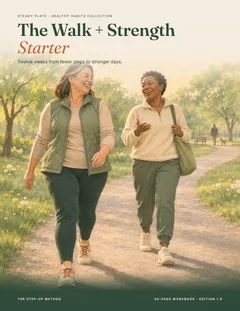
A 12-week step plan from your own baseline and eight at-home strength exercises.
Sources
- Volpi E, Nazemi R, Fujita S. Muscle tissue changes with aging. Curr Opin Clin Nutr Metab Care. 2004;7:405-10. PMC2804956
- World Health Organization. WHO guidelines on physical activity and sedentary behaviour. 2020. who.int
- O'Donovan G et al. Association of "weekend warrior" and other leisure time physical activity patterns with risks for all-cause, cardiovascular disease, and cancer mortality. JAMA Intern Med. 2017;177:335-42. doi.org
Educational information, not medical advice. Sources checked 21 November 2026.