How these numbers are worked out
Protein
The minimum is the adult Recommended Dietary Allowance of 0.8 g of protein per kg of body weight per day, set by the US National Academies to prevent deficiency.1 It is a floor, not a target for weight loss.
The weight-loss reference of 1.0 g per kg comes from research on adults over 50 losing weight, where higher protein intakes (1.0 g per kg or more) helped them keep more lean mass.2 A meta-analysis of 24 trials also found that higher-protein, reduced-calorie diets led to slightly more fat loss and better protection of lean tissue; the effect was modest.3
The per-meal figure simply divides the day by three meals. It is not a rule; it is a way to make the daily number easier to picture.
Check with your doctor first if you have kidney disease or have been told to limit protein, or if you are pregnant.
Steps
The 12-week plan starts from your current average and adds a little every two weeks, the progression used in the Walk + Strength Starter. These increases are our practical suggestion, not a research finding.
The health range comes from a pooled analysis of 15 studies with 47,471 adults: the risk of death fell as daily steps rose, levelling off at about 6,000 to 8,000 steps for adults 60 and over and 8,000 to 10,000 for younger adults.4 That study measured long-term health, not weight loss. The WHO separately recommends 150 to 300 minutes of moderate activity a week.5
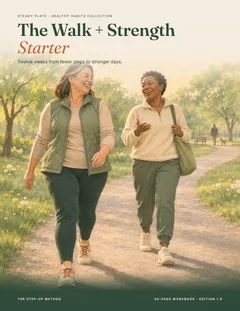
The full 12-week step plan, the talk test for brisk walking and eight at-home strength exercises.
Sources
- Wolfe RR et al. Optimizing protein intake in adults: interpretation and application of the Recommended Dietary Allowance compared with the Acceptable Macronutrient Distribution Range. Adv Nutr. 2017. pmc.ncbi.nlm.nih.gov/articles/PMC5347101
- Kim JE et al. Effects of dietary protein intake on body composition changes after weight loss in older adults: a systematic review and meta-analysis. Nutr Rev. 2016. pmc.ncbi.nlm.nih.gov/articles/PMC4892287
- Wycherley TP et al. Am J Clin Nutr. 2012;96:1281-98. pubmed.ncbi.nlm.nih.gov/23097268
- Paluch AE et al. Daily steps and all-cause mortality: a meta-analysis of 15 international cohorts. Lancet Public Health. 2022. pubmed.ncbi.nlm.nih.gov/35247352
- Bull FC et al. WHO 2020 guidelines on physical activity and sedentary behaviour. Br J Sports Med. 2020. pmc.ncbi.nlm.nih.gov/articles/PMC7719906
Educational information, not medical advice. Checked 21 November 2026.