- The adult minimum is 0.8 g of protein per kg of body weight per day.1
- Studies of weight loss in adults over 50 found that 1.0 g per kg or more helped people keep more muscle.2
- Higher-protein diets led to slightly more fat loss in a meta-analysis of 24 trials. The effect was modest.3
- A simple way to get there: a palm-sized portion of protein at each meal.
If you have searched "how much protein to lose weight", you have probably seen numbers from 50 grams a day to "one gram per pound". The honest answer is less dramatic and more useful. Protein matters during weight loss, mostly because it helps you hold on to muscle while you lose fat, and it helps meals keep you full. But it is one part of the plate, not a magic lever.
The minimum: 0.8 g per kg
The Recommended Dietary Allowance (RDA) for adults is 0.8 g of protein per kilogram of body weight per day. It was set to cover the needs of almost all healthy adults and has stayed at that level for decades.1 For a person weighing 80 kg (about 176 lb), that is 64 g a day.
The RDA is designed to prevent deficiency. It was not designed for someone who is eating less in order to lose weight, which is why many researchers look at higher intakes for that situation.1
What weight-loss studies used
When people eat fewer calories, part of the weight they lose is lean tissue, which includes muscle. Two lines of research are useful here.
Higher versus standard protein. A meta-analysis of 24 trials (1,063 people, about 12 weeks each) compared reduced-calorie diets that were higher or standard in protein. The higher-protein diets led to about 0.8 kg more weight loss and 0.9 kg more fat loss on average, and better protection of lean tissue.3 Those are real but modest differences.
Adults over 50. A review of weight-loss trials in older adults found that higher protein intakes, of 1.0 g per kg or more, helped people keep more lean mass while they lost weight.2 This matters more with age, because muscle is harder to rebuild later.
A practical reference point
| Body weight | Minimum (0.8 g/kg) | Weight-loss reference (1.0 g/kg) | Per meal (÷3) |
|---|---|---|---|
| 60 kg / 132 lb | 48 g | 60 g | about 20 g |
| 80 kg / 176 lb | 64 g | 80 g | about 27 g |
| 100 kg / 220 lb | 80 g | 100 g | about 33 g |
These are reference points, not prescriptions. You can calculate your own in the free protein and steps calculator.
Why per meal matters more than per day
Most people eat little protein at breakfast and most of it at dinner. Spreading it across the day is easier to manage and tends to make breakfast and lunch more filling. The simplest guide is your hand: a palm-sized portion of protein at each meal. Hands scale with body size and you always have one with you.
Easy ways to get a palm of protein
- Breakfast: Greek yogurt with berries and oats; two eggs on wholegrain toast; cottage cheese with fruit.
- Lunch: a can of tuna or beans in a salad; leftover chicken in a wrap; lentil soup.
- Dinner: fish, chicken, tofu or lean meat with half a plate of vegetables.
Beans and lentils count twice: they bring protein and fiber at the same time, which is why they appear in so many steady-plate meals.
Protein is one quarter of the plate
The Harvard Healthy Eating Plate gives a simple layout: half the plate vegetables and fruit, a quarter whole grains, a quarter healthy protein, plus healthy oils and water.4 Getting protein right without the vegetables and fiber usually leaves people hungry and constipated. The plate keeps things in balance.
Check with your doctor or a registered dietitian first if you have kidney disease or have been told to limit protein, if you are pregnant, or if you have any condition that needs a special diet.
The bottom line
Aim for at least the minimum, and for most adults trying to lose weight, somewhere around 1.0 g per kg is a sensible, research-backed reference point. Spread it across your meals, build the rest of the plate around vegetables and fiber, and do not expect protein alone to do the work.
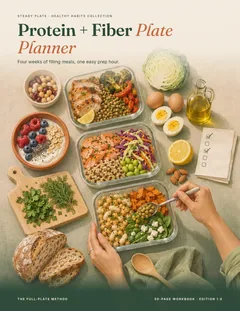
Four weeks of meals with protein at every meal, 24 recipes, four shopping lists and a one-hour prep routine.
Sources
- Wolfe RR et al. Optimizing protein intake in adults: interpretation and application of the Recommended Dietary Allowance compared with the Acceptable Macronutrient Distribution Range. Adv Nutr. 2017. PMC5347101
- Kim JE et al. Effects of dietary protein intake on body composition changes after weight loss in older adults. Nutr Rev. 2016. PMC4892287
- Wycherley TP et al. Effects of energy-restricted high-protein, low-fat compared with standard-protein, low-fat diets: a meta-analysis. Am J Clin Nutr. 2012;96:1281-98. PubMed 23097268
- Harvard T.H. Chan School of Public Health. The Healthy Eating Plate. nutritionsource.hsph.harvard.edu
Educational information, not medical advice. Sources checked 21 November 2026.