- There is no single magic number. 10,000 steps is a round figure, not a research threshold.
- In a pooled study of 47,471 adults, health benefits levelled off around 6,000 to 8,000 steps (60 and over) and 8,000 to 10,000 (under 60).1
- The WHO recommends 150 to 300 minutes of moderate activity a week, plus strength work twice a week.2
- The best target is a little more than you do now, raised slowly.
"How many steps a day to lose weight" is one of the most searched walking questions, and most answers start at 10,000. If you currently walk 3,500 steps on a desk day, that number can feel like a reason not to start. Here is what the research actually says, and a gentler way to use it.
Where 10,000 comes from
Ten thousand is a memorable round number. It is not a cut-off where something special happens. The most useful recent evidence looks at how health changes across the whole range of daily steps.
What the big step study found
A 2022 meta-analysis combined 15 studies following 47,471 adults. The more steps people took each day, the lower their risk of dying during the study period, up to a point. The benefit levelled off at about 6,000 to 8,000 steps a day for adults aged 60 and over, and about 8,000 to 10,000 for younger adults. Walking speed did not add a separate effect once total steps were counted.1
Important: that study measured long-term health, not weight loss. Steps are worth increasing for many reasons, but no step count guarantees a number on the scale. Weight loss mostly depends on eating a little less than you use, and steps support that alongside the plate.
What activity guidelines recommend
The World Health Organization recommends that adults get 150 to 300 minutes of moderate-intensity activity a week, or 75 to 150 minutes of vigorous activity, plus muscle-strengthening activities on two or more days.2 Brisk walking is the easiest way for most people to get the moderate minutes.
How brisk is brisk?
Use the CDC's talk test: during moderate activity you can talk but not sing.3 If you can sing, speed up a little. If you can only say a few words, slow down.
A gentler way to build up
Start from your own number. Count an ordinary week without changing anything, then add a little at a time. This is the progression used in the Walk + Strength Starter; the step sizes are our practical suggestion.
| Weeks | Daily target |
|---|---|
| 1 | Count your baseline. Change nothing. |
| 2 | Baseline, plus three 10-minute brisk walks |
| 3 to 4 | Baseline + 500 |
| 5 to 6 | Baseline + 1,000 |
| 7 to 8 | Baseline + 1,500 |
| 9 to 10 | Baseline + 2,000 |
| 11 to 12 | Baseline + 2,500, or hold |
Get your personal version in the free protein and steps calculator.
Where the extra steps come from
- Walk during phone calls that do not need a screen.
- Ten minutes outside before or after lunch.
- A short walk after dinner, alone or with family.
- Park a little further away, or walk to the nearest shop.
- One floor by stairs instead of the lift.
On a desk day, two ten-minute walks add up quickly, and short walks count the same as one long one toward weekly minutes.
Do not skip strength
Walking is excellent, but the guidelines also recommend strength work on at least two days a week, covering the major muscle groups.2 At home, a chair, a wall and a backpack are enough to start: sit-to-stands, wall push-ups, glute bridges and backpack rows.
Check with your doctor first if you have a heart condition, chest pain or dizziness with activity, recent surgery, or joint pain that gets worse with walking.
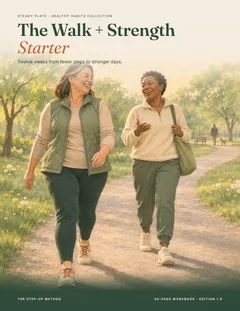
A 12-week step plan from your own baseline, eight illustrated at-home exercises and if-then plans for rainy days.
Sources
- Paluch AE et al. Daily steps and all-cause mortality: a meta-analysis of 15 international cohorts. Lancet Public Health. 2022;7:e219-28. PubMed 35247352
- Bull FC et al. World Health Organization 2020 guidelines on physical activity and sedentary behaviour. Br J Sports Med. 2020. PMC7719906
- Centers for Disease Control and Prevention. How to Measure Physical Activity Intensity. cdc.gov
Educational information, not medical advice. Sources checked 21 November 2026.