Every November the same number appears: the average person gains five pounds over the holidays. It sounds precise. When researchers went looking for the source, they could not find a credible one.
What the study actually measured
Researchers at the US National Institutes of Health weighed 195 adults several times, from the autumn before the holidays to the autumn a year later. Across the holiday period, the average gain was 0.37 kg, a little under one pound.1 Some people gained more: those who were already heavier tended to gain more, and a minority gained over five pounds.
Why a small gain still matters
The weight gained over the holidays was, on average, not lost by the following autumn.1 A pound a year is easy to ignore, which is exactly why it adds up over a decade. The goal for December is not to lose weight. It is to not keep the pound.
A calm plan for party season
| Moment | One small habit |
|---|---|
| The big dinner | Fill half the plate with vegetables first, then enjoy everything else. |
| After the meal | A 10-minute walk. Light walking after eating lowered blood sugar compared with sitting in pooled lab studies.3 |
| Drinks | Alternate each drink with a glass of water. A standard US drink has 14 g of alcohol, and alcohol has about 7 calories per gram.2 |
| The next morning | Back to your normal breakfast. No skipping, no "making up for it". |
Skip the January crash
The days after a big holiday meal are when people swing to the other extreme. A crash plan in January is the same fast-then-regain cycle in a new month. Keep the habits that were working in November and pick them back up on the first normal day.
Talk to your doctor before changing how you drink if you take medication, or if you have diabetes, since alcohol can affect blood sugar.
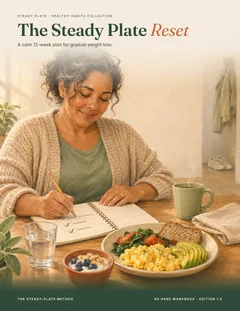
The 12-week method: a gradual pace, one repeatable plate, light tracking and calm four-week reviews.
Sources
- Yanovski JA et al. A prospective study of holiday weight gain. N Engl J Med. 2000;342:861-7. PubMed 10727591
- National Institute on Alcohol Abuse and Alcoholism. What is a standard drink? niaaa.nih.gov
- Buffey AJ et al. The acute effects of interrupting prolonged sitting time in adults with standing and light-intensity walking on biomarkers of cardiometabolic health in adults: a systematic review and meta-analysis. Sports Med. 2022;52:1765-87. springer.com
Educational information, not medical advice. Sources checked 21 November 2026.