- Cook components, not meals: a tray of vegetables, a pot of lentils, a grain and a protein.
- Most Americans eat only about 58% of the recommended 14 g of fiber per 1,000 calories.1 Add it slowly.
- Cooked leftovers keep 3 to 4 days in the fridge, or 3 to 4 months in the freezer.2
- Build each meal on the plate: half vegetables, a quarter protein, a quarter whole grains or beans.3
Protein and fiber are the two things that make a meal keep you full, and the two things most busy weeks are missing. Prepping them ahead, in about an hour, is the simplest way to make the filling option the easy option on a Tuesday night.
Why protein and fiber together
Protein helps protect muscle when you eat a little less, and higher-protein reduced-calorie diets led to slightly more fat loss in a meta-analysis of 24 trials.4 Fiber is the part of plant foods your body does not digest. The US recommendation is 14 g per 1,000 calories, about 25 g a day for women and 38 g for men, and the average American eats only around 58% of that.1 Beans and lentils give you both at once.
The one-hour routine
| Minutes | Oven and hob | Your hands |
|---|---|---|
| 0 to 10 | Oven on. Water on for grains. Lentils simmering. | Chop vegetables for one roasting tray. |
| 10 to 15 | Vegetables in the oven. Grains in the pot. | Season chicken or tofu. |
| 15 to 40 | Protein on a second tray. Eggs boiling. | Make a cabbage slaw. Rinse beans. Wash fruit. |
| 40 to 50 | Everything out. Lentils and grains drained. | Spread hot food in shallow containers to cool. |
| 50 to 60 | Oven off. | Pack lunch boxes; label everything with the day cooked. |
Store it safely
The USDA advises eating cooked leftovers within 3 to 4 days, or freezing them, where they keep for 3 to 4 months. Cool food quickly by dividing it into shallow containers, and keep the fridge at 40°F (4°C) or below.2 If your prep has to last a full week, cook a fresh grain or a second tray of vegetables on Wednesday. Cook fish fresh on the day.
A sample week
| Meal | Built from your prep |
|---|---|
| Breakfast | Greek yogurt with berries, oats and chia; or two eggs with spinach on rye. |
| Lunch | Lentils, roasted vegetables and quinoa with a little feta; or chicken, quinoa and slaw. |
| Dinner | Sheet-pan chicken with broccoli and potatoes; a big lentil and vegetable soup; turkey and bean chili. |
| Snack | Apple and peanut butter; vegetable sticks with hummus. |
Add fiber without the bloating
Fiber is trending online, and the direction is right. The speed often is not. Going from little fiber to a lot overnight is a common cause of bloating. A slower approach (our suggestion):
- Add one fiber-rich food for a few days before adding the next.
- Drink water with fiber-rich meals, and rinse canned beans.
- Mix types: vegetables, fruit, oats, beans, lentils, whole grains, nuts and seeds.
- If you feel bloated, hold where you are for a few days rather than stopping.
Cooking for a family
You do not need two menus. Prep components that everyone eats, and let each person build their own plate. Teenagers can take a bigger portion of grains; you build yours with half vegetables. Sheet-pan dinners, chili and tacos already fit the plate.
Check with your doctor first if you have kidney disease, an inflammatory bowel condition, or have been given a low-fiber or low-protein diet.
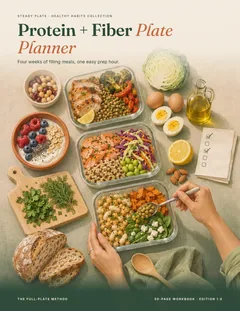
Four full weeks of this routine: weekly menus, 24 recipe cards, four shopping lists and a slow fiber plan.
Sources
- USDA Economic Research Service. Charts of Note: fiber intake relative to the Dietary Guidelines for Americans 2020-2025. ers.usda.gov
- USDA Food Safety and Inspection Service. Leftovers and Food Safety. fsis.usda.gov
- Harvard T.H. Chan School of Public Health. The Healthy Eating Plate. nutritionsource.hsph.harvard.edu
- Wycherley TP et al. Am J Clin Nutr. 2012;96:1281-98. PubMed 23097268
Educational information, not medical advice. Sources checked 21 November 2026.