Most people do not need another app. They need a way to put a sensible meal together without thinking too hard. That is what the plate method is for.
The plate
The Healthy Eating Plate from the Harvard T.H. Chan School of Public Health splits a plate into simple zones: half vegetables and fruit, a quarter healthy protein, a quarter whole grains, with healthy oils and water on the side.1 Steady Plate uses the same idea with hands, so it works anywhere.
| Part of the plate | Hand guide | Examples |
|---|---|---|
| Half: vegetables | Two open hands | Salad, roasted vegetables, frozen mixed vegetables |
| A palm of protein | Your palm, size and thickness | Chicken, fish, eggs, tofu, Greek yogurt, lentils |
| A quarter: fiber-rich carbs | A cupped hand | Beans, oats, brown rice, whole-grain bread, potatoes with skin |
| A thumb of fat | Your thumb | Olive oil, nuts, avocado, cheese |
Start with vegetables
In a Penn State lab study, women who started lunch with a large, low-calorie salad (about three cups, lightly dressed) ate about 12% fewer calories at the meal overall than when they skipped the salad.2 A heavy dressing or cheese-loaded salad would not have the same effect.
Eating out
- Order a side of vegetables or a salad first.
- Picture the plate and leave what falls outside it, or box it up.
- Ask for sauces on the side.
A sample day
| Meal | Plate |
|---|---|
| Breakfast | Greek yogurt with berries and a spoon of oats; a handful of nuts |
| Lunch | Big salad, chicken or chickpeas, a slice of whole-grain bread, olive oil dressing |
| Dinner | Roasted vegetables, salmon or tofu, a cupped hand of brown rice |
Cooked leftovers keep 3 to 4 days in the fridge, so one batch of components can cover several lunches.3
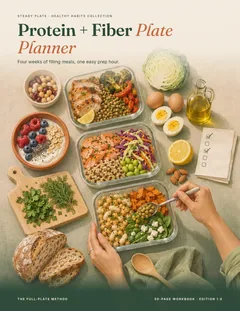
Four weeks of filling meals, 24 recipes, four shopping lists and a one-hour prep routine.
Sources
- Harvard T.H. Chan School of Public Health. The Healthy Eating Plate. hsph.harvard.edu
- Rolls BJ, Roe LS, Meengs JS. Salad and satiety: energy density and portion size of a first-course salad affect energy intake at lunch. J Am Diet Assoc. 2004;104:1570-6. PubMed
- USDA Food Safety and Inspection Service. Leftovers and food safety. fsis.usda.gov
Educational information, not medical advice. Sources checked 21 November 2026.